Andrew First Imprisons Nina in the Attic
The HousemaidAndrew First Imprisons Nina in the Attic is the turning point at which Nina Winchester discovers that Andrew Winchester’s apparent perfection conceals deliberate, coercive cruelty. He tricks her into entering the Attic Room, locks her inside, and treats her dark roots as grounds for punishment, demanding that she pull one hundred hairs from her own scalp before he will let her out. What begins as an ostensibly practical request becomes a lesson in how Andrew makes the conditions of Nina’s confinement—and even her appearance—subject to his control.
The Pretext and the Locked Door
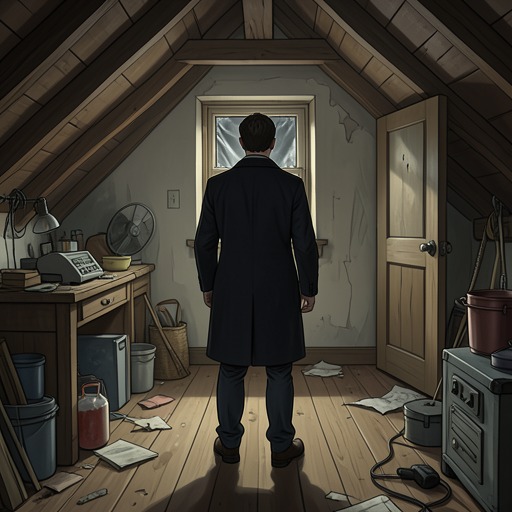
Nina has been living in the Winchester home for about four months when Andrew asks for her help finding work papers in the upstairs storage area. He says he needs them to finish a contract that night, and couples the request with the promise of spending time together afterward. Nina has never been inside the storage area: on an earlier attempt, while Cecelia was napping, she found the door locked and turned back. Andrew’s casual assurance that the space contains nothing but papers makes this new invitation seem ordinary.
The search is a setup. Andrew directs Nina to a closet near the bed and says he keeps everything there, but the closet contains nothing except a blue bucket. There are no papers to find. As Nina tries to understand what he expects her to do, a door slams; Andrew has left the small room and shut her inside. The discrepancy between the promised task and the empty closet makes clear that the papers were never the point. The pretext gets Nina into a room she has not been able to enter before, while the locked door gives Andrew control over what happens next.
Andrew Names the Punishment
For a time, Nina tries to make sense of Andrew’s absence as an accident. After half an hour of shouting and pounding on the door, she hears him on the other side. She tells him she has been locked in and asks whether he heard her screaming. Andrew confirms that he did. His answer removes the possibility that he simply failed to notice her distress: he has heard her and chosen not to respond.
When Nina demands to be let out, Andrew tells her that she must learn her lesson before she can leave. His insistence that she cannot tell him what to do in his own house turns the home itself into the authority behind the confinement. Nina recalls that while they were engaged she had seen Andrew as sweet, romantic, handsome, wealthy, and good to Cecelia; she had searched for his fatal flaw and now recognizes it. The change is not a revelation of some hidden imperfection in his manners, but a reversal in the meaning of his apparent kindness: Andrew can present himself as a devoted husband and father while deliberately imprisoning his wife.
The chapter marks the scene as Step Three in Nina’s account of how to discover that a husband is evil. Three hours after the initial confrontation, she is still at the door, scraping and pounding until her fingernails splinter and her voice gives out. Andrew eventually explains the supposed offense: he is disgusted by the dark roots showing in her hair and says he cannot have his wife walking around looking like a slob. Nina apologizes and promises to make a hairdresser’s appointment, but an apology does not end the punishment. Andrew recasts an ordinary feature of her appearance as disobedience requiring consequences.
The Hair Demand and the Cost of Release
Andrew demands that Nina give him one hundred strands of hair. He specifies that he wants the strands from her scalp, with the roots attached, and tells her to put them in envelopes from the dresser and slide them under the door. He presents compliance as the route out: if she supplies the hair, she will have learned her lesson and he will release her. When Nina agrees, he says he has to go to work and expects the strands to be ready when he returns. The demand is not merely a threat of pain; it makes Nina perform the punishment on herself and turns the act of obedience into the price of freedom.
By seven o’clock, Nina has gathered the hundred strands. About twenty come free as she repeatedly runs her fingers through her hair; she plucks the remaining eighty out by the roots, one at a time, because pulling several together is agonizing. She notes that the hair follicles have to remain intact. Her reflection that, after having Cecelia, she would have had to pluck herself bald to obtain enough usable hair connects the punishment to her changed body after childbirth. The task is therefore both exacting and personal: Andrew’s arbitrary standard makes Nina’s own body the instrument and material of his control.
Nina waits for Andrew to count the strands, fearing that he might decide she has failed and keep her locked in for another twelve hours. She thinks of Cecelia as the reason she must continue, unwilling to leave her daughter with Andrew. At last he says she has done a good job, and the lock turns. Andrew is dressed for work when he opens the door; Nina, who had imagined being strong enough to attack him, is too weak to get up from the floor. He brings her a glass of water and a bagel. She accepts both because she needs food and water and does not believe she can get out otherwise. Her wish to serve him divorce papers sits alongside this immediate dependence: the door has opened, but the punishment has left her depleted and her marriage’s future settled in her mind.
Consequences and Significance
The episode establishes a pattern in which Andrew controls Nina through confinement, arbitrary rules, and conditional relief. He first creates the isolation, then defines a trivial matter as an offense, and finally sets a painful task that Nina must complete to regain access to the household. His occasional provision of food does not undo that violence; the water and bagel arrive only after she has endured the locked room and fulfilled his demand, and she takes them because her strength is gone.
For Nina, the first imprisonment changes the meaning of the home and of the man she believed she had married. Andrew’s own words confirm that the confinement is intentional, while the hair punishment shows how easily he can convert his preference about her appearance into a rule enforced by physical suffering. Her concern for Cecelia keeps her focused on surviving the ordeal, even as she begins to imagine leaving Andrew. The locked door, the empty closet, the envelopes, and the counted strands trace the scene’s progression from deception to forced compliance—and establish that Nina’s apparent domestic security has become a system of control.